Author Archives: Haley

Unknown's avatar

About Haley

A millennial whose real work begins after 5pm.

2021 Chicago Waste Strategy

Late last month, under the leadership of Chicago’s Chief Sustainability Officer Angela Tovar and on behalf of Mayor Lightfoot, the City released the 2021 City of Chicago Waste Strategy (executive summary here). This report was created in collaboration with the Delta Institute, a local consulting firm specializing in municipal solid waste management planning. UIC provided analysis and the current condition assessment that informed the proposed strategies. This renewed attention is great to see, especially considering Chicago’s shameful claim to the worst big-city recycling rate. The plan offers a mix of concrete steps to reduce, mitigate, and divert waste, while others remain a bit vague. The broad aim is to “minimize landfilling, increase diversion and recycling, reduce cost, and increase efficiency, maximize economic investment and work and environmental justice inequities.” The City is also (supposedly) “committed to working with our partners, businesses, sister agencies, residents, institutions, and environmental leaders who are committed to achieving a zero-waste future.”

Obviously, the City will need a significant effort to improve its abysmal recycling and waste record. And it’s incredibly frustrating, to say the least, to learn that even if you are recycling properly your recycling may be headed to the landfill instead – which a 2018 Better Government Association investigation found Waste Management was doing by diverting a significant amount of supposedly “contaminated” recyclables into the garbage (which, coincidentally, profited WM). Thankfully, the City appears to finally not only be willing to recognize this issue but also to rectify it. Earlier this year, the Department of Streets and Sanitation (DSS) eschewed Waste Management and opted for a 3-year contract with a competitor, LRS, for residential recycling. LRS “possess[es] more recycling assets than any other Company in the Chicago area, including a state-of-the-art single-stream recycling facility that can sort cardboard, mixed-paper, glass, steel, other metals and plastics” (note, however, that per this Report the City is considering abandoning the single-stream recycling system in favor of a multi-stream system). LRS is committed to collecting recycling with less than 50% of contamination. There will be no change in areas where DSS services blue carts.

DSS and the Chicago Department of Public Health also received a grant from the National Resource Defense Council (NRDC) to work on food waste reduction in 2021, a part of the NRDC’s Food Matters initiative partnering with cities to achieve meaningful reductions in food waste through comprehensive policies and programs. You can read more about the NRDC’s initiatives in the Midwest here. Side note: the NRDC also received a $100 million grant from the Bezos Earth Fund last year to accelerate climate action.

The report follows a series of “Guiding Principles” that demonstrate a broader concern for climate change and environmental equity:

  • Reframe Chicago’s materials as resources, instead of waste: This encompasses including sustainable materials management practices in Chicago’s climate mitigation and adaptation strategies; changing existing perceptions using educational programs; configuring Chicago’s materials management system away from disposal; and shifting materials interventions upstream to capture value and materials before they enter any waste stream.
  • Center equity and environmental justice in program design: Consider neighborhood-specific impacts; prevent unintended consequences; and avoid creating additional burdens for low-to-moderate-income (LMI) Chicagoans.
  • Identify opportunities for establishing internal and external partnerships: Clarify and documenting the role of City offices to determine how to improve coordination; partner with early organizational adopters already pushing innovation in waste reduction; and identify how the City can create the conditions to sustain impactful partnerships and a more participatory materials management system.
  • Prioritize initiatives with revenue potential, no/low cost, or a positive return on investment when applied at scale: Identify opportunities for economic benefit, revenue generation, and additional cost savings through materials management; consider budget realities to develop realistic strategies; and prioritize critical investment needs to meet identified goals.
  • Identify opportunities to include goal setting, metrics, and data sharing to demonstrate progress and increase transparency: Develop opportunities to share data and resources with the community; prioritize routing, equitable stakeholder engagement; and establish goals and metrics for success and how those metrics will be realistically evaluated.
  • Equip consumers with the education and tools needed to drive innovation in evolving waste systems: Consider investments in public education; prioritize stakeholder engagement; and highlight opportunities for Chicago to act as a national leader in sustainability.

I have to say, even these guiding principles are ambitious – but hopefully not unrealistically so. For Chicago to act as a “national leader in sustainability,” considering its current track record, will take enormous change and a shift in mindset. It is good to see a recognition of the inequitable nature of climate change and its effects and an effort to address these inequities in the waste management strategy going forward.

Before moving into priorities and implementation, the report provides an Existing Conditions Report, Waste Characterization and Generation Update Report, Peer City Analysis, and Materials Management Strategies.

The meat of the plan offers a number (63, to be exact) of Materials Management Strategies to be considered, presenting those strategies determined to be optimal (more complex and demanding), practical (can be readily implemented at full scale), and pilot (strategies ready for site-specific implementation). The strategies are also categorized according to projected cost (low, mid, or high range).

The Plan then delineates short-term priorities for 2021 and 2022, but no specific targets or deadlines (Evanston, by contrast, has an immediate goal of reaching a 50% waste diversion rate by 2025). However, one promising goal is to provide compostable food drop-off locations by the end of the year. Still, this will require significant public education in conjunction with the actual infrastructure in order to actually be effective.

The short-term priorities for 2021-2022 fall under three categories: Policy Review and Exploration, Increasing Opportunities for Community Interventions, and Strengthening Internal Operations. Notable among these priorities are:

  • Policy Review and Exploration: The City seeks to review existing materials management ordinances to identifyopportunities to increase impact and conduct initial research for new potential legislation.
    • Research potential for implementing waste hauling zones for commercial waste
    • Support ambitious statewide extended producer responsibility (EPR) legislation
    • Assess Construction & Demolition Debris (C&D) Recycling Ordinance compliance and identifying opportunities for increased contractor education
    • Adjust the C&D Recycling Ordinance to specify targeted material types and parameters for reuse
  • Increasing Opportunities for Community Interventions: The City seeks to provide new programs and educational opportunities for residents to engage with the materials management system and improve residential diversion.
    • Leverage the NRDC Food Matters Great Lakes Regional Cohort to pilot food waste prevention and recycling programs
    • Maintain clear and consistent messaging around recycling contamination
    • Introduce organics drop off locations through seasonal “pumpkin smash” events
    • Develop a directory of participating retail take-back options for e-waste and household hazardous waste (HHW)
    • Establish a revenue-sharing partnership with a textile recycling company for collection of clothes, shoes, and other textiles otherwise ending up in landfills
  • Strengthening Internal Operations: The City seeks to improve internal operations related to materials management to increase efficiency across departments and improve waste diversion in the City.
    • Identify appropriate Blue Cart to black cart distribution and bin size options
    • Improve high density residential recycling ordinance compliance
    • Improve the existing yard waste collection program and incorporate potential food scrap “ride along” options

In addition, some potential longer-term strategies that stick out to me are:

  • Decreasing contamination in recycling and introducing additional recycling streams (the current single-stream recycling system is more expensive and has more contamination)
  • Better enforcement of recycling violations
  • Implementing city-run commercial recycling (currently they contract privately)
  • More Blue Bin education (what is actually accepted)
  • Reevaluating the number, size, and distribution of black and blue carts. A “Pay As You Throw” model may even be implemented (paying for bigger trash bins), which is advocated by the U.S. Environmental Protection Agency and adopted by communities across the country.
  • Clothing and textile recycling: “establishing a revenue-sharing partnership with a textile recycling company for collection of clothes, shoes, and other textiles otherwise ending up in landfills.”
  • Update the 2013 Chicago Energy Benchmarking Ordinance to add waste tracking requirements for large commercial buildings
  • Support ambitious statewide extended producer responsibility (EPR) legislation “requir[ing] manufacturers to take financial responsibility for the end-of-life recovery or safe disposal of their products.”
  • Establish a grant program for development of secondary markets
  • Deprioritize waste incineration and Waste to Energy (W2E) operations until further research and technology development.
  • Leverage the NRDC Food Matters Great Lakes Regional Cohort “to conduct a food rescue assessment of existing infrastructure and gaps”
  • Expand material types available for collection and diversion through the HCCRF and rebrand the facility as a Chicago Recycling Center and increase access
  • Increase residential organic waste and food scrap collection services
  • Promoting and creating infrastructure for composting

This post was written with help and insights from an article recently published by WBEZ authored by Monica Eng. Monica is sadly moving on from WBEZ, but as a longtime follower and admirer I am excited to see what she will accomplish next!
Starbucks is allowing personal cups again!

Big news for Starbucks lovers like me (sorry, not sorry). Starbucks has finally resumed its personal cup program! Bring your own cup for ¢10 off your beverage, but more importantly to save a plastic cup and lid (FYI, hot beverage cups are not recyclable). And I can almost guarantee that your cup is better insulated than theirs.

Buy Nothing & Freecycle

I’m all about buying pre-owned, but what’s better than free? My local Buy Nothing group has been an amazing resource for giving and receiving items no longer needed by others!

Buy Nothing is a concept popularized by the Buy Nothing Project, a social experiment started in 2013 (though people have been practicing similar philosophies for years). The Buy Nothing Project is comprised of a global network of community groups that encourage forsaking conventional commerce in favor of giving or recycling consumer goods and services. The Buy Nothing Project’s mission is “set[ting] the scarcity model of our cash economy aside in favor of creatively and collaboratively sharing the abundance around us.”

Freecycling is a similar concept. On freecycle.org, registered users (membership is free) can post items they are giving away or are in search of (ISO) on a Craigstlist-like platform. Trash Nothing is another freecycling platform offered in Chicago. However, I have found less transparency on Freecycle – users are not as responsive and it’s more difficult to determine whether an item has been taken.

I am often hesitant to donate many items because I don’t trust that they will just be pitched. With these groups, I’ve been able to find new homes for niche items – particularly craft and personal care items – knowing that they are actually wanted. Plus, it’s fun to see what other people are offering up – you never know what might strike your fancy! But act fast – popular items get claimed quickly.

Also, don’t worry — you don’t actually have to [gasp] interact with people. Most pick-ups and drop-offs are contactless porch pickups.

Here is a list of neighborhood Buy Nothing Facebook groups (please let me know if I’m missing any):

The Fallacy of the Three R’s

Earth Month is coming to an end, and while I love seeing so much content surrounding Earth Month, there has been a good deal of corporate greenwashing surrounding the cause and unfortunately some attention to our planet may wane on May 1. This is why I felt it important to address the distortion associated with the infamous three R’s.

Recall the waste hierarchy 3 R’s: Reduce, Reuse, Recycle. We’re all familiar with the adage – it was drilled into me in elementary school. Notice that Recycle comes last. Yeah, that’s no accident. However, over time we’ve flipped this hierarchy by order of priority – it seems that recycling has moved from the last spot up to the first.

But alas, it often is not. Not to mention the enormous energy required to recycle for a relatively small output. Recycling, or the myth of, enables us to forsake reducing and reusing based upon the flawed notion that our recyclables are easily reformed and reused. But that couldn’t be farther from the truth.

I used to think I was a good environmentalist because I recycled everything. I hardly had any trash but filled up my recycling bin. Plastic? No problem – it’s recyclable!

If you recycle, that’s great. Too few actually do (a smidge over a third of Americans) and that’s an absolute shame. But recycling does not absolve us – far from it. While we give ourselves a pat on the back for recycling and feeling that we are doing our part by doing so, it is unfortunately an often fruitless task. Many municipalities hardly support recycling, and often even those who do have nowhere to put it. The U.S. used to ship its recycling overseas, but that avenue has largely been shut off to us. According to the EPA, in 2018 (the latest available data) 68% of discarded paper and cardboard was recycled, 25% of glass, and only 9% of plastics were recycled.

Glass and metal can be recycled indefinitely, which makes recycling these materials actually worthwhile. Paper can be recycled five to seven times before it’s too degraded to be made into “new” paper. It can also be composted. Plastic, however, can only be recycled once or twice—and usually not into a food container—since the polymers break down in the recycling process. As a Columbia University Climate School article put it: “Plastic recycling presents the biggest challenge because the plastic is often contaminated by other materials and consumer goods companies are reluctant to buy recycled plastic unless it is as pure as virgin plastic.” Therein lies the core of the problem – recycling plastic usually isn’t worth it.

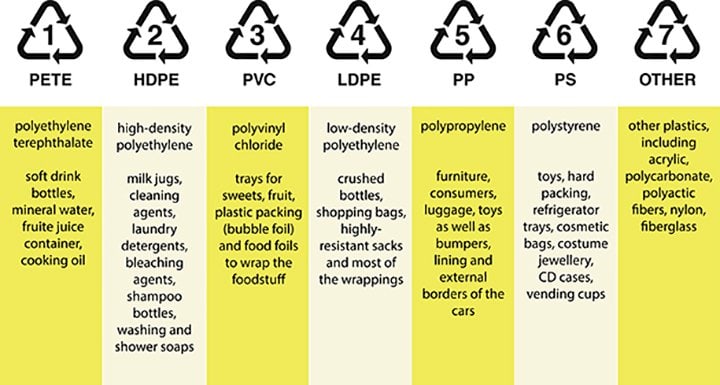
To add another layer, there are many types of plastic. These are usually classified on the plastic itself for recycling sorting, and it is important to pay attention these numbers are your city may not accept all numbers. Chicago accepts plastics with the numbers 1, 2, 3, 4, 5 or 7. Note number 6 (polystyrene), which the city does not accept: including toys, hard packing, cosmetic bags, jewelry, CD cases, and vending cups. WTTW also provides a list of common items that cannot be recycled (with my notes):

  1. Plastic bags, film and bubble wrap (many grocery and hardware stores will accept plastic bags)
  2. Foam
  3. Food waste
  4. Greasy cardboard (e.g., pizza boxes – separate the clean portion) and paper
  5. Electronics and cords (many can be recycled at Best Buy or the Household Chemical & Computer Recycling Facility)
  6. Batteries (alkaline batteries can go in the trash; rechargeable and lead acid batteries should go to the Household Chemical & Computer Recycling Facility
  7. Toner cartridges (Best Buy, OfficeMax, and Staples will accept these)
  8. Used napkins, paper towels and tissues
  9. Liquids
  10. Poly-lined beverage cups
  11. Biodegradable or compostable plastics
  12. Plastic cutlery, straws or other #6 plastics.

When in doubt, here is a comprehensive list of typical products that Chicago does and does not accept in its Blue Cart Program. Earth911.com is another great resource for finding where you can recycle more difficult items.

Some difficult-to-recycle items, such as plastic pouches and cosmetics, might be recycled through a closed-loop recycling program such as those partnered with Terracycle. Before you throw something out, check to see if Terracycle or the brand itself accepts it back to be repurposed. I have a hard time finding skincare brands that don’t use plastic, but at least I can use brands such as Beekman1802. We also save up and ship in our Thomas Bagels bags!

We often over-recycle and do so incorrectly. As you can see above, not all plastic is recyclable, and much depends on where you live. I think we feel good about recycling even those things that cannot be recycled (e.g., Styrofoam) when we’re actually doing more harm than good. This is probably a good time to reiterate that adding something contaminated or dangerously sharp, such as broken glass, can cause the whole bin to be trashed. It’s better to start correctly from the beginning, even if that means more in your garbage bin.

Let’s circle back to the first two R’s – Reduce and Reuse. The best way to avoid the amount of waste, particularly plastic waste, is to reduce your consumption. Consumerism in our culture is rampant. Goods are more plentiful and cheaper than ever, which certainly has its benefits but comes at an enormous cost to our environment and our fellow humans who are inhumanely exploited to produce these goods. Not to mention these are often the very same people whose water and soil is being poisoned by textile factories producing cheap goods for us to buy. All to make cents. Take a moment to consider this when purchasing a cheap garment on Amazon or any of the plethora of impossibly cheap sites or fast fashion houses. It is too good to be true. Also, these designs are often ripped off from independent designers who receive no credit and might even be driven out of the space entirely due to being undercut by cheap counterfeits.

            To boil it down: Don’t buy crap you don’t need.

Now, finally, onto “Reuse.” If you buy something, try to have an exit strategy. Can it be resold or donated (will someone else want it)? Thrifting is one method of reusing items and extending their lifecycle. Can it be mended if broken? Even cheap items can have a long lifespan if treated properly and mended rather than being thrown away. Can it be reused in some other way? For example, old t-shirts and other garments can be re-used as rags, and takeout containers can be used for leftovers or bulk food. Can it otherwise be disposed of responsibly? Sometimes, the answer is unfortunately no – which is why it is important to also reduce the amount of our stuff that eventually ends up in landfills and to cherish and care for what we already own. A classic example is a reusable coffee tumbler or water bottle – even though these cannot easily be disposed of at the end of their lifecycle, think of how many disposable coffee cups and plastic water bottles (ugh) were saved over that time! The same can be said for reusable tote bags, but if you’re anything like me, that can kind of be overdone.

To not rely on recycling as a crutch requires a significant shift in mindset. Corporations have engaged us in a massive effort of cognitive dissonance – we put so much effort into attempting to recycle correctly, but the end goal is not what we are led to believe. Furthermore, corporations have put the onus on us individuals rather than themselves. This is why it is crucial to prioritize reducing and reusing before recycling, which in many ways has been distorted to incentivize us to buy more and make us feel less guilty about our waste. It’s a farce that we are finally beginning to see through.

Sustainable Shopping (Thrifting, Donating, Reselling)

Shopping and stuff is easier to come by, and cheaper, than ever. But this comes at significant environmental and human cost. According to the Ellen MacArthur Foundation, clothing production roughly doubled in between 2000 and 2015 and the number of times a garment is worn was reduced by approximately 36%. According to the World Economic Forum, 60% more garments were purchased but were only kept by consumers for half as long. This correlates with the meteoric rise of fast fashion retailers such as H&M and Forever 21, which churn out massive amounts of cheap clothing that quickly deteriorates or is thrown out (though, to their credit, they are trying to combat this). My own purchasing habits seem to track this trend – with affordable clothing readily available, for a long time I didn’t see any issue with buying more of it. However, the equivalent of one garbage truck full of clothes is burned or dumped in a landfill every second. One film I cannot recommend enough is The True Cost (you can, and I acknowledge the hypocrisy in saying this, stream it on Amazon). This exposé explores the dark side of fast fashion and the human rights violations and environmental destruction that sustain it.

You have likely noticed that sustainability has become trendy, for lack of a better term, in the fashion world. But beware – this is often a marketing tactic backed with only token measures, if any. Vague claims of being eco-friendly or sustainable make a company more attractive to more customers, leading them to buy more products. Let’s be real – a company adopting an eco-friendly image does not mean it practices what it preaches or has a legitimate interest in the environment. It’s marketing. This “corporate greenwashing” can actually have harmful effects if a company highlights its sustainability to distract from other unsustainable practices.

If you are going to buy new, choosing natural fibers reduces greenhouse gas emissions – synthetic fibers are made from fossil fuels, with an energy-intensive production process that emits toxic gases like N20, which is 300 times more damaging than CO2. Even natural fibers, however, both use and pollute enormous amounts of water. Cotton, for instance, requires immense amounts of water but is typically grown in hot and dry climates – where water is a precious resource. One cotton shirt requires approximately 2,700 liters of water. Microplastics are also shed when washing and even merely wearing synthetic clothing, sending these tiny particles of plastic to our natural waterways – polluting and harming animals and humans alike.

Unfortunately, however, if you are buying anything new there is an environmental cost. I have been complicit to our culture of consumerism, but am striving to buy secondhand – I have a goal for myself to buy only (okay, mostly) secondhand. Purchasing secondhand can reduce an item’s climate footprint by 73%!

I primarily use Poshmark to buy, but more-so to sell, clothes (check out my closet). If you’re interested in trying it, you can use my referral code for a $10 credit! However, nothing beats the joy of the hunt in thrifting and here are some of my favorite thrift stores in Chicago (mostly North side):

Responsible Disposal

I am always trying to get rid of crap. It’s a constant battle that actually requires considerable strategy. I have been off-loading my used clothing through online selling, consigning, and thoughtful donations.

When donating, I have to ask whether something I’m giving away is something someone might actually want. If not, it could very well end up in the trash or shipped overseas, which doesn’t exactly help the planet. And if it’s crap to me, it’s likely crap to someone else too. My husband’s old undershirts and other used tees, for instance, instead go to Marine Layer for their Respun program. Otherwise, I generally donated to St. Vincent de Paul, the Brown Elephant (especially furniture), and the Salvation Army.

I also recently donated several nicer dresses to a Zengeler Cleaners location, which partners with the Glass Slipper Project and Mothers Trust Foundation to give prom dresses to prom-goers in need. Full disclosure – I have no idea what constitutes a prom dress nowadays, so I used my best judgment and gave contemporary dresses that I felt are appropriate for prom. Accessories, small purses, dress shoes, and makeup can also be donated.

I sell as much as I can online (mostly Poshmark, but also eBay) or via consignment (I consign with Elliott Consignment & McShane’s Exchange). I’ve sold hundreds of items this way, though unfortunately by looking at my closet you would never know. I don’t think of this as making money, but more like un-spending. It helps to offset my shopping budget. Selling my clothes ensures that, at least for the time being, these pieces will go to someone who wants them. Whether they end up in a landfill is out of my control, but their lifespans are being extended and someone is opting to buy used rather than new. I can also re-use shipping and gift materials I have laying around rather than throwing them away! Again, even if these end up in the trash at least they are being used once more before then.

Our consumerist culture has indoctrinated us with the idea that clothes (among other goods) can be disposable. Unless it is soiled beyond saving, clothing does not belong in the trash – you can sell it, donate it, or upcycle it. As inconvenient as it may be, we must be responsible consumers and take ownership and responsibility for our stuff and the consequences it has on our planet and fellow humans. Reduce and reuse, then recycle.

Composting

Before I discuss composting, I must briefly address what is perhaps the root of the problem – food waste. Chicagoans waste approximately 55 million pounds of food each month. This is particularly jarring because 1 in 9 Illinoisans (and 1 in 8 children) are food insecure. A 30% reduction in food waste, which should be easy to do, could feed all of America’s hungry. Food waste is wasteful at every stage of the food production, and then a significant portion is thrown into the trash while our fellow citizens go hungry. It is also a waste of money.

In Illinois, nearly 3 million tons of food waste is sent to landfills each year – more than any other single waste stream found in landfills. When food waste decomposes in these anaerobic conditions (without oxygen), it produces methane, a powerful greenhouse gas that is 25 times more harmful than carbon dioxide. Greenhouse gases trap radiation in the Earth’s atmosphere, which gradually raises the planet’s average temperature. Composting can divert much of this food waste from landfills and reduce methane production by providing aerobic (with oxygen) conditions for decomposition where methane-producing microbes are not present. In the presence of oxygen and water, microbes, such as bacteria and fungi, use the carbon for energy and decompose the organic waste. This produces heat, which kills pathogens and seeds, and the remaining carbon is stable “humus” (commonly called mulch) that is weed-free and safe to use for agriculture, landscaping, gardening or other purposes. So-called “clean” composting can reduce water pollution, repair topsoil, naturally fertilize crops without harmful pesticides, and even sequester carbon from the atmosphere, among other benefits. Composting might be the most impactful way to reduce your carbon emissions and, I will tell you, we rarely have to take out the trash (optimal in this frigid weather).

Unfortunately, the City of Chicago does not offer composting services. This is a great topic to write to your alderperson about, and one that requires far greater recognition than it currently has. Chicagoans are apparently barely recycling, not to mention composting (also, according to WBEZ, Waste Management is notorious for rejecting recycling bins as contaminated and having these bins send to the landfills they may own, potentially profiting twice). Monica Eng at WBEZ provides a great explanation for why Chicago does not provide composting and what it would take for it to do so. Yard waste, however, is banned from landfills in Illinois – you can use 311 to easily schedule a yard waste pickup, which in my experience is picked up speedily. However, if a pickup is not scheduled then the dump truck will take it away as they are supposed to pick up anything in the alleys.

Alas, since the city does not offer municipal composting, we’re on our own here. Unfortunately, this is one example of sustainability and environmentalism not exactly equitable – this “lifestyle” requires resources in the forms of education, time, money, and space.

If you have an outdoor space, composting outside is a great option – for example, we have a little pile outside of our back door. However, compost scraps can be fodder for rats, and also cannot effectively break down many of the materials that a commercial composting facility can (such as paper, animal products, and sturdier biodegradable materials).

Enter composting services, which are making composting easier than ever (prior to 2015, most composting services were effectively prohibited and compost collection was severely restricted – the ordinance has since been amended to facilitate compost pick-up and drop-off). Around Chicago, there is a growing number of companies offering pickup and drop-off composting.

  • Blockbins: Blockbins is the most affordable option, and the one I use personally. For $10 per month, you are given an access code to the community bin closest to you which you share with several neighbors. You can also request your own bin, which you will sponsor and pay slightly more for until more people subscribe. However, there is currently a significant backlog for bin requests (I’ve been on the list for well over a year now). But there are plenty of bins citywide so chances are there is one no more than a few blocks away!
  • Dill Pickle Co-Op: Dill Pickle Co-Op provides a compost drop-off service. For a $19.99 deposit, you can take home a compost bucket. Pay $9.99 ($5.99 for co-op members) every time you drop off the bucket and are given a clean one.
  • Green City Market: Partnered with Healthy Soil Compost, for $3, shoppers can drop off their own container or bag of organic waste at the Info Booth at the Lincoln Park, West Loop, and Indoor markets.
  • Greendirt Compost: Greendirt provides a bin and weekly collection. Your scraps are vermicomposted (with worms), and Greendirt will give you a bag of worm castings (essentially mulch) each month for your plants! Plans start at $19.99/month with savings for longer subscriptions.
  • Healthy Soil Compost: Healthy Soil Compost provides residential and commercial compost pickup services. Healthy Soil also provides a bucket which you fill with compost and can have retrieved and replaced monthly ($20), twice a month ($30), or weekly ($40). You can also purchase mulch!
  • Collective Resource Compost: Collective Resource Compost is a woman-owned, Evanston-based compost pickup service. Collective Resource also provides a 5-gallon bucket which you fill with compost and can have retrieved and replaced monthly ($20.50), twice a month ($15.50), or weekly ($10.50). Collective Resource also operates a 32-gallon “Neighbor Totes” community composting program similar to that of Blockbins.
  • The Urban Canopy: The Urban Canopy offers residential and commercial compost pickup as part of its “Compost Club.” They provide a 5-gallon bucket which you fill with compost and can have retrieved and replaced monthly ($15/month), twice a month ($25/month), or weekly ($35/month). Additionally, for every 10 pickups members are given a $5 voucher to Plant Shop Chicago or City Grange Garden Center, a $5 voucher to a local farmers market, or a $5 voucher to a restaurant that is part of the Compost Club. The Urban Canopy also provides commercial and community composting, beginning in March 2021.
  • WasteNot Compost: You might see WasteNot’s nifty electric truck scooting around the city doing compost pickups. WasteNot provides a bucket, which you fill up and leave outside for WasteNot to pick up and replace with a clean bucket. Treehugger (https://www.treehugger.com/best-composting-services-5074856) deemed WasteNot one of its best composting services in the country in 2020! WasteNot provides residential, multi-unit, and commercial services. WasteNot provides weekly ($10/pickup) and biweekly ($12/pickup) service.

Interested in supporting businesses that compost? Check out the Illinois Food Scrap Coalition (IFSC)’s list of “We Compost” partners.

Are you composting, or are you eager to start? Share your experiences or any questions below!

Simple Steps: Turn Down the Heat

I’m typing with a steaming mug of tea and a dog warming up my toes. Because baby, it’s cold outside. And buckle up — it’s going to be a frigid, pipe-freezin’ weekend.

Our house is old and not super efficient – that’s a post for another day – and letting the dog out every time she sees a squirrel (or leaf) brings in a frigid draft. But in order to feel cozy our household is emitting tens of thousands of pounds of CO2 (estimate what your household’s carbon emissions are using the EPA’s calculator).

I don’t know about you all, but my last utility bill was rough. And we don’t keep it that warm! But when the temperatures dip our furnaces are working extra hard to maintain the same temperature. Nonetheless, I’m taking steps to make sure our carbon emissions are reduced even during the current cold spell. For one, I’m keeping the house relatively cool. I run cold, but I can always put on another sweater or pair of socks – really, if you’re in shorts and a t-shirt in the dead of winter you’re doing it wrong.

Is it worth it? Yes. By reducing your home’s temperature by merely one degree overnight, you can save roughly 1,000 pounds of CO2 from being emitted (as well as saving a good deal of money). And the bigger your home, the more you are emitting — which comes with more responsibility to offset your emissions and more room to do so.

I highly recommend a smart thermostat, such as one by Nest (ComEd often provides discounts). If I forget to turn the heat down before I leave the house, or even if I’m too lazy to go downstairs, I can use the app to do so remotely. I also have schedules set to, for instance, turn the heat down overnight and back up just prior to waking up.

This is one super simple step you can take to reduce your own carbon emissions – even by tens of thousands of pounds per month. Being warm is an absolute luxury, and there is no need to harm the planet even more by turning your place into a sauna.

Reading Sustainably (and Cheaply)

I love books. I love looking at them, smelling them, feeling them, and of course, reading them. I also love buying them, and take pride in what I consider to be a beautiful and impressive library.

But then I ran out of room. And then we had to move all of those books. And then, to my horror, our basement flooded shortly after we moved in and a number of those books were damaged or ruined (most tragically, my early editions of The Chronicles of Nania). And then, many of those I thought had been salvaged grew moldy. What a mess.

So, away went many of these books. I composted what I could and threw the rest out. But honestly, I shouldn’t have been holding onto many of these books anyway and took a hard look at those that remained. I started leaving books out front to be picked up by passer-bys and gave a bunch away to friends and charity.

Long story short, going forward I have essentially resolved to buy no more new books. There are some exceptions – namely, those I may buy at speaker events (when those are a thing again) and/or have autographed. But otherwise I am resigning myself to my old Amazon Fire and secondhand books as well as working through those books I already have. Here are two fun and easy ways you can free up space in your home, wallet, and ultimately the landfill when it comes to reading:

  1. Utilize your local library. The Chicago Public Library is back open, and along with its immense physical catalogue you can use your library card to access e-books and audiobooks that are delivered to apps such as Kindle and Audible. CPL uses Overdrive, which has a handy app called Libby. You just punch in your library card number and are given access to the library’s entire catalog where you can check out or be added to the list for any ebook or audiobook. I enjoy the Kindle and Audible libraries, but just cannot justify purchasing a book that I’ll only read once and cannot pass on (though Audible allows you to return an audiobook within a year with Audible Plus). But nothing beats free, which the library is.

  2. Buy secondhand. I love buying books for next to nothing at Nearly New Thrift Store and the Salvation Army. At a charity shop, your purchase goes to a good cause and you can simply re-donate the book when you’re done. If you’re looking for a wider variety, here are several used books stores that could certainly use your support:

If you need to buy a new book, that’s fine (as my dad aptly pointed out, writers need our support). But don’t throw it away…because that is literally sacrilege.

The world breaks everyone, and afterward, some are strong at the broken places
– Ernest Hemingway, A Farewell to Arms

This line, from one of my favorite novels, has been on my mind recently. Though in a different time and context than Hemingway wrote of following World War I, I find it incredibly relevant today. Our world and our country are broken, and the past four years have been particularly shattering. However, with the change of administration comes renewed hope and resolve, including a monumental hope for positive environmental change.

I think many of us are suffering from something akin to PTSD from the past four years (exacerbated by a pandemic) – it’s no secret that the last administration was absolutely devastating for environmental regulation (the Berkeley Law Center has a comprehensive list of rollbacks). But it’s time to move forward and the Biden Administration is doing just that. In the first few days of his presidency, Biden has taken swift action to make climate and environment a policy priority. Already, President Biden has taken executive actions* to:

  • Rejoin the Paris Climate Agreement (effective February 19)
  • Revok the Keystone XL Pipeline’s federal permit
  • Pledged to review a laundry list of Trump administration regulatory actions aimed at propping up high-emitting industries
  • Ban new leases and permits for fossil fuels
  • Restore national monuments (Bears Ears and Grand Staircase-Escalante)
  • Place a temporary moratorium on all oil and gas drilling in the Arctic National Wildlife Refuge
  • Advance oil and gas methane regulations, energy efficiency standards for appliances, and the air toxic rule for power plants

*While executive actions bypass the need for Congressional approval, they can be challenged by the courts (which currently lean conservative).

This is great progress, but only the beginning and more must be done to aggressively curb climate change. While President Biden has taken steps to revert to many of the Obama Administration’s climate policies, the Biden Administration cannot simply stop there and does not plan on doing so.

Expect to see a resurgence of clean air, clean water, and clean power, and for it to be more economically viable. These are growing sectors that will have downstream effects, changing the way we live in positive and practical ways. The world was broken, but we’re going to build it back better.

Welcome!

I thought blogging ended in 2013, but here we are. This is a little passion project of mine starting to come to life.

There is a lot of ignorance about environmentalism and sustainability, and while this ignorance is often innocent, unfortunately it is also often willful. This site will work to confront this ignorance and hopefully provide information that everyone can use.

I am also painfully aware that much of environmentalism and crafting a sustainable lifestyle comes from a place of privilege. Along with greenwashing (which I will address at some point), I have noticed a great deal of whitewashing. And I’m no exception to that. However, I wish to make sustainability as accessible to everyone — after all, the goal is to create a better Earth for everyone and it is lower income communities which suffer disproportionately from pollution and the effects of climate change.

Perhaps most importantly, I try not to judge – even in the face of willful ignorance. We all have to start somewhere, and making sustainability and environmentalism as open and accepting as possible will make others feel welcome and embrace change that betters ourselves and our planet. I stopped eating meat over 10 years ago, and every year has been an education and improvement in how I can reduce my own environmental impact. I’m far from zero waste, or even plastic-free, but I’m trying. One person isn’t going to make much of a difference, but collectively we can do some real good. Let’s learn and grow together!