Earth Month is coming to an end, and while I love seeing so much content surrounding Earth Month, there has been a good deal of corporate greenwashing surrounding the cause and unfortunately some attention to our planet may wane on May 1. This is why I felt it important to address the distortion associated with the infamous three R’s.
Recall the waste hierarchy 3 R’s: Reduce, Reuse, Recycle. We’re all familiar with the adage – it was drilled into me in elementary school. Notice that Recycle comes last. Yeah, that’s no accident. However, over time we’ve flipped this hierarchy by order of priority – it seems that recycling has moved from the last spot up to the first.
But alas, it often is not. Not to mention the enormous energy required to recycle for a relatively small output. Recycling, or the myth of, enables us to forsake reducing and reusing based upon the flawed notion that our recyclables are easily reformed and reused. But that couldn’t be farther from the truth.
I used to think I was a good environmentalist because I recycled everything. I hardly had any trash but filled up my recycling bin. Plastic? No problem – it’s recyclable!
If you recycle, that’s great. Too few actually do (a smidge over a third of Americans) and that’s an absolute shame. But recycling does not absolve us – far from it. While we give ourselves a pat on the back for recycling and feeling that we are doing our part by doing so, it is unfortunately an often fruitless task. Many municipalities hardly support recycling, and often even those who do have nowhere to put it. The U.S. used to ship its recycling overseas, but that avenue has largely been shut off to us. According to the EPA, in 2018 (the latest available data) 68% of discarded paper and cardboard was recycled, 25% of glass, and only 9% of plastics were recycled.
Glass and metal can be recycled indefinitely, which makes recycling these materials actually worthwhile. Paper can be recycled five to seven times before it’s too degraded to be made into “new” paper. It can also be composted. Plastic, however, can only be recycled once or twice—and usually not into a food container—since the polymers break down in the recycling process. As a Columbia University Climate School article put it: “Plastic recycling presents the biggest challenge because the plastic is often contaminated by other materials and consumer goods companies are reluctant to buy recycled plastic unless it is as pure as virgin plastic.” Therein lies the core of the problem – recycling plastic usually isn’t worth it.
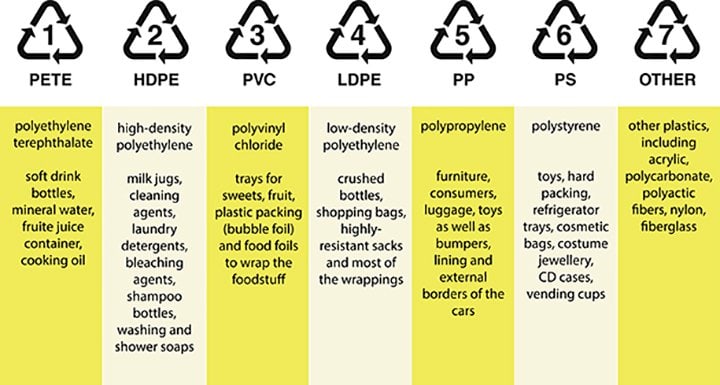
To add another layer, there are many types of plastic. These are usually classified on the plastic itself for recycling sorting, and it is important to pay attention these numbers are your city may not accept all numbers. Chicago accepts plastics with the numbers 1, 2, 3, 4, 5 or 7. Note number 6 (polystyrene), which the city does not accept: including toys, hard packing, cosmetic bags, jewelry, CD cases, and vending cups. WTTW also provides a list of common items that cannot be recycled (with my notes):
- Plastic bags, film and bubble wrap (many grocery and hardware stores will accept plastic bags)
- Foam
- Food waste
- Greasy cardboard (e.g., pizza boxes – separate the clean portion) and paper
- Electronics and cords (many can be recycled at Best Buy or the Household Chemical & Computer Recycling Facility)
- Batteries (alkaline batteries can go in the trash; rechargeable and lead acid batteries should go to the Household Chemical & Computer Recycling Facility
- Toner cartridges (Best Buy, OfficeMax, and Staples will accept these)
- Used napkins, paper towels and tissues
- Liquids
- Poly-lined beverage cups
- Biodegradable or compostable plastics
- Plastic cutlery, straws or other #6 plastics.
When in doubt, here is a comprehensive list of typical products that Chicago does and does not accept in its Blue Cart Program. Earth911.com is another great resource for finding where you can recycle more difficult items.
Some difficult-to-recycle items, such as plastic pouches and cosmetics, might be recycled through a closed-loop recycling program such as those partnered with Terracycle. Before you throw something out, check to see if Terracycle or the brand itself accepts it back to be repurposed. I have a hard time finding skincare brands that don’t use plastic, but at least I can use brands such as Beekman1802. We also save up and ship in our Thomas Bagels bags!
We often over-recycle and do so incorrectly. As you can see above, not all plastic is recyclable, and much depends on where you live. I think we feel good about recycling even those things that cannot be recycled (e.g., Styrofoam) when we’re actually doing more harm than good. This is probably a good time to reiterate that adding something contaminated or dangerously sharp, such as broken glass, can cause the whole bin to be trashed. It’s better to start correctly from the beginning, even if that means more in your garbage bin.
Let’s circle back to the first two R’s – Reduce and Reuse. The best way to avoid the amount of waste, particularly plastic waste, is to reduce your consumption. Consumerism in our culture is rampant. Goods are more plentiful and cheaper than ever, which certainly has its benefits but comes at an enormous cost to our environment and our fellow humans who are inhumanely exploited to produce these goods. Not to mention these are often the very same people whose water and soil is being poisoned by textile factories producing cheap goods for us to buy. All to make cents. Take a moment to consider this when purchasing a cheap garment on Amazon or any of the plethora of impossibly cheap sites or fast fashion houses. It is too good to be true. Also, these designs are often ripped off from independent designers who receive no credit and might even be driven out of the space entirely due to being undercut by cheap counterfeits.
To boil it down: Don’t buy crap you don’t need.
Now, finally, onto “Reuse.” If you buy something, try to have an exit strategy. Can it be resold or donated (will someone else want it)? Thrifting is one method of reusing items and extending their lifecycle. Can it be mended if broken? Even cheap items can have a long lifespan if treated properly and mended rather than being thrown away. Can it be reused in some other way? For example, old t-shirts and other garments can be re-used as rags, and takeout containers can be used for leftovers or bulk food. Can it otherwise be disposed of responsibly? Sometimes, the answer is unfortunately no – which is why it is important to also reduce the amount of our stuff that eventually ends up in landfills and to cherish and care for what we already own. A classic example is a reusable coffee tumbler or water bottle – even though these cannot easily be disposed of at the end of their lifecycle, think of how many disposable coffee cups and plastic water bottles (ugh) were saved over that time! The same can be said for reusable tote bags, but if you’re anything like me, that can kind of be overdone.
To not rely on recycling as a crutch requires a significant shift in mindset. Corporations have engaged us in a massive effort of cognitive dissonance – we put so much effort into attempting to recycle correctly, but the end goal is not what we are led to believe. Furthermore, corporations have put the onus on us individuals rather than themselves. This is why it is crucial to prioritize reducing and reusing before recycling, which in many ways has been distorted to incentivize us to buy more and make us feel less guilty about our waste. It’s a farce that we are finally beginning to see through.
 Sustain(able) Chicago